Years ago I ran an A/B test on a landing page. Version A was gorgeous. Proper design, illustrations, the works. Version B was plain. One headline, one button.
B won. Clearly.
I still think about that test every time someone tells me they “know” which ad will work. Nobody knows. You find out.
On Snapchat, that’s even more true, because most of your ads won’t even get the chance.
The math nobody puts in their test plan
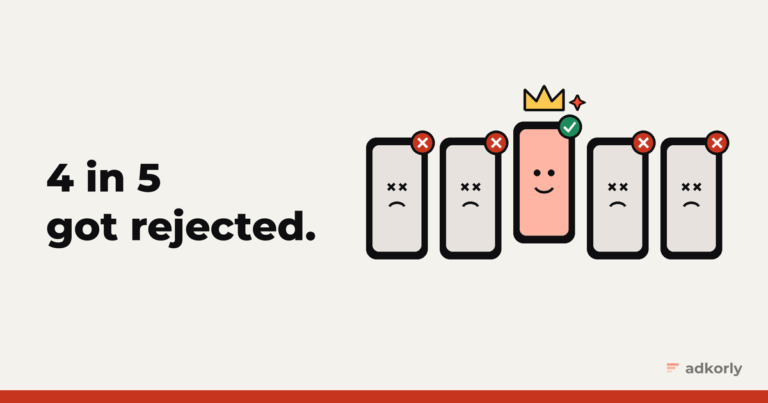
We tracked 58,000 Snapchat ads through review. In accounts that work, about 3 in 4 got rejected. (The full data is here.)
So here’s what a “test” usually looks like:
- You make 10 videos.
- 7 or 8 get rejected.
- The 2 or 3 that survive get a tiny budget each.
- You decide the angle doesn’t work.
That’s not a test. That’s a raffle.
Flip it around and plan backwards from the ads you need live:

- Want 10 ads running? Upload about 40.
- Of those 10, maybe 3 spend well.
- Of those 3, with some luck, 1 is a winner you can scale.
The exact numbers after review will vary for you. The shape won’t.
Why volume beats the perfect ad
The affiliates who make the most money on Snapchat aren’t better at guessing. They’re faster at finding out.
They have:
- Plenty of accounts, so one bad day doesn’t stop the machine.
- Plenty of creatives, so rejections don’t kill a test.
- A fast read on what got through, so they spend their time on winners, not on chasing review.
If 3 in 4 ads get rejected, the person who uploads 40 learns four times faster than the person who polishes 10. Same budget. Very different month.
How to structure a test that tells you something
Keep it boring. Boring tests give clear answers.
- One offer, one country, one objective. Change one big thing at a time.
- Test angles first, not edits. “Saves you time” vs “saves you money” vs “your friends already use it”. The angle is the big lever.
- Then test hooks. The first second decides most of it. Same video, five different openings.
- Then formats. UGC style vs screen recording vs talking head.
- Group by angle in ad squads, so the results stay readable. One angle per ad squad, several hooks inside it.
When to kill and when to scale
Rules of thumb, not commandments:
- Kill an ad that spent 2 to 3 times your target cost per result with nothing to show for it.
- Kill an angle when none of its hooks get there after a fair spend.
- Scale slowly. Raise budgets in steps, don’t double overnight.
- Keep feeding the machine. Your winner will get tired. Start testing its replacement while it’s still winning.
And one rule that’s not a rule of thumb: only judge ads that actually ran. Check review status before you check results. A rejected ad didn’t lose the test. It never took it.
The boring part that makes or breaks it
Here’s where testing at volume usually dies. Not in strategy. In operations.
- Uploading 40 videos one by one into Ads Manager.
- Topping up accounts by card, and the card saying no.
- Refreshing review status like it’s a crypto chart.
- Finding a new account when one gets suspended mid test.
I spent three years on a side project that went nowhere, until it suddenly did. The only reason it got there was that I kept shipping things. Same here: the teams that win are the ones whose operations let them keep shipping.
That’s the part we built Adkorly for. You request accounts, fund them from one wallet, send us your videos and we push them in bulk. You see what got approved and what didn’t, and you spend your time on the winners.
What’s your current test volume on Snapchat? 10 videos a week? 100? Tell me, I’m curious where most people are.
Cheers,
Johannes