A year ago, “ads in ChatGPT” was a joke on Twitter.
Now it’s reportedly a billion-dollar-a-year business, and every affiliate group chat I’m in asks the same question: can I run my offers there?
Short answer: probably not the ones you’re thinking of. Long answer below.
Last checked on 4 November 2026. This changes monthly.
How we got here, in one minute
- January 2026. OpenAI says ads are coming to ChatGPT.
- February. Testing starts in the US, for logged-in adults on the Free and Go plans. Big brands only. Reports talked about a $200,000 minimum and a CPM around $60.
- May. A self-serve Ads Manager opens in the US, with cost-per-click bidding and no big minimum.
- August to October. Self-serve opens in Europe, India, the Middle East and more countries.
So yes, today you can sign up and run ads in ChatGPT yourself. The question is what.
What ChatGPT ads look like
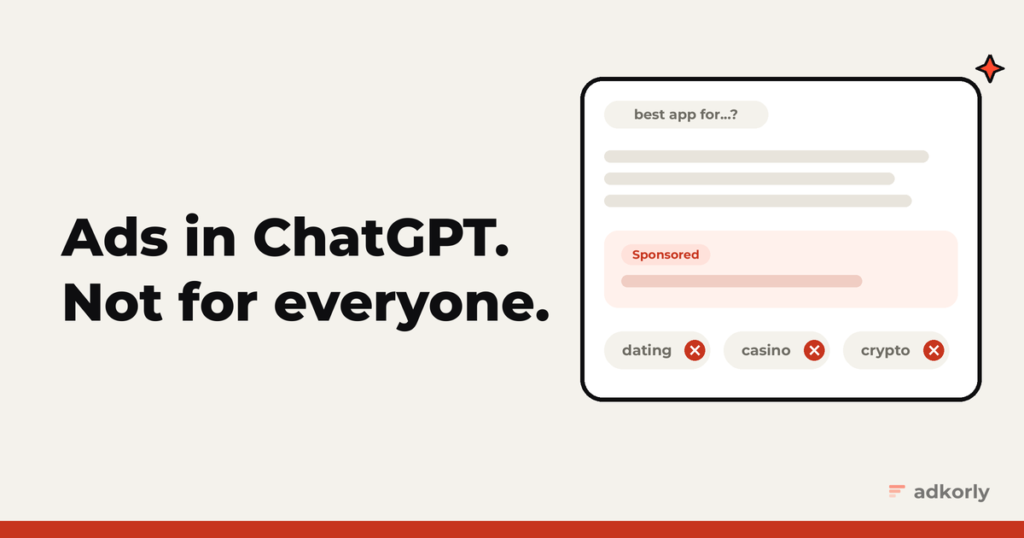
A sponsored unit under ChatGPT’s answer, clearly labelled. The answer itself is not the ad.
A few things that matter:
- Not every conversation gets ads. None in health, mental health, politics or other sensitive chats.
- Paying users mostly don’t see them. The ads launched on the Free and Go plans.
- You get aggregated data, not user data. No “show my ad to people who asked about X last week” retargeting.
It feels a lot like early Google search ads: someone asks a real question, and your ad sits right under the answer. That’s the appeal.
What they cost
The honest answer: OpenAI doesn’t publish a rate card.
What’s out there:
- At launch: reports said about $60 CPM and a six-figure minimum.
- Now: third parties report CPMs around $25 to $60 and clicks from about $3, much more in finance. Treat that as a rough guide, not a price list.
For comparison, the affiliates in our accounts paid €1.33 to €3.14 CPM on Snapchat this year. So per view, ChatGPT is something like 10 to 20 times more expensive.
You’re not paying for views. You’re paying for someone in the middle of a decision. Whether that’s worth it depends entirely on what you sell.
Which offers are banned (the important part)
Here’s where most affiliates can stop reading. OpenAI’s ad policy, last updated in June 2026, bans:
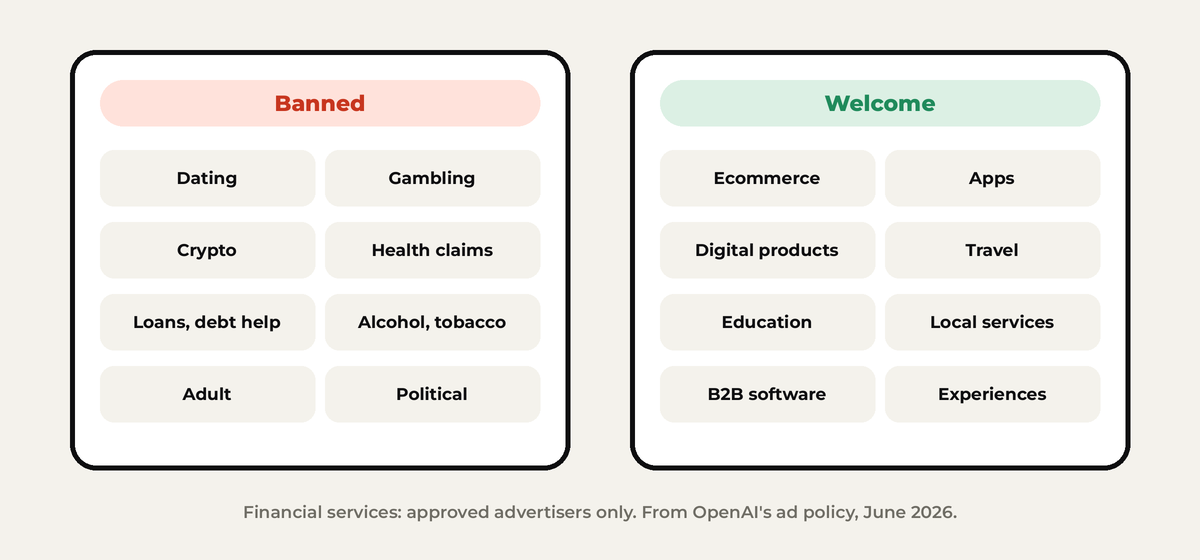
- Adult content, including dating apps and sexual health products
- Gambling, with narrow exceptions for travel and entertainment
- Crypto
- Credit repair and debt settlement
- Health claims you can’t back up, plus regulated medical products
- Alcohol, tobacco and recreational drugs, cannabis included
- Legal services, political ads, counterfeit goods and scams
Financial services are restricted to approved advertisers, case by case.
And a few rules that hurt affiliates in particular:
- The landing page must match the ad. No bait and switch.
- Destinations get reviewed. “Unverified messaging channels” are banned, so “DM us on Telegram” is out.
- No exaggerated results or fake endorsements. In any category.
Dating, casino, crypto, nutra with big claims, loans. That’s the classic affiliate top five, and it’s all banned or restricted. Ouch.
What OpenAI says it wants instead: ecommerce, local services, travel, apps and digital products, and education.
So should affiliates care?
Yes, for three reasons.
- If your offer is allowed, the intent is unusual. Someone asking “what’s the best budgeting app for freelancers?” is a lot closer to buying than someone scrolling Stories.
- It changes search either way. More people ask ChatGPT instead of Google. Even if you never buy an ad there, being the answer it gives matters more every month.
- Don’t move your grey budget there. Strict categories plus reviewed landing pages means accounts get shut down fast. Same lesson as Snapchat, where about 4 in 5 ads we tracked got rejected, except here the whole category is off the table.
If you want to test it
- Pick an offer that’s clearly allowed, with a clean landing page that says exactly what the ad says.
- Start on cost per click with a small budget. And keep an eye on it, since daily budgets can reportedly run over on busy days.
- Write the ad like a good answer. Useful, specific, no hype. You’re sitting under an AI that just gave a thoughtful reply. “BUY NOW 80% OFF!!!” will look exactly as bad as it sounds.
- Set up conversion tracking on day one, so you judge on cost per sale, not on a pretty click-through rate.
- Give it two weeks, then compare cost per sale with your best channel. Not CPM. Cost per sale.
Where this leaves Snapchat
Snapchat’s rules aren’t loose either. Gambling needs a licence, dating has restrictions, and review is strict. But a lot of performance offers that ChatGPT won’t touch do run there, at a fraction of the CPM.
That’s the world we work in at Adkorly: ad accounts, one wallet, and review data across a lot of Snapchat ads. If ChatGPT just said no to your offer, here’s what Snapchat looks like.
Have you tried ChatGPT ads yet? What did you pay per click, and did anything convert? I’d love some real numbers to add here. Tell me.
Cheers,
Johannes