Every ad tech deck this year has the word “agentic” on slide two. Usually next to a robot.
(Ours too. I’m not innocent here. There’s a robot on this very post.)
So I went through what the platforms have actually shipped, what the case studies actually say, and where people got burned. Here’s the honest version for media buyers.
Last checked on 2 November 2026.
What “agentic” actually means
Two things get mixed up all the time.
Automation is what you’ve had for years. Advantage+, Performance Max, Smart+. The platform optimizes inside its own walls toward a goal you set. Useful, but it’s not new and it’s not an agent.
Agentic means an AI model, like Claude, ChatGPT or Gemini, that plans the steps itself, uses tools to do them, checks the result and keeps going. Anthropic’s definition, quoted by Digiday: “systems where LLMs dynamically direct their own processes and tool usage.”
My quick test: if you can say “find the three worst ad sets from last week and pause them” and it does it, that’s agentic. If it’s a toggle in Ads Manager, it’s automation with a new sticker.
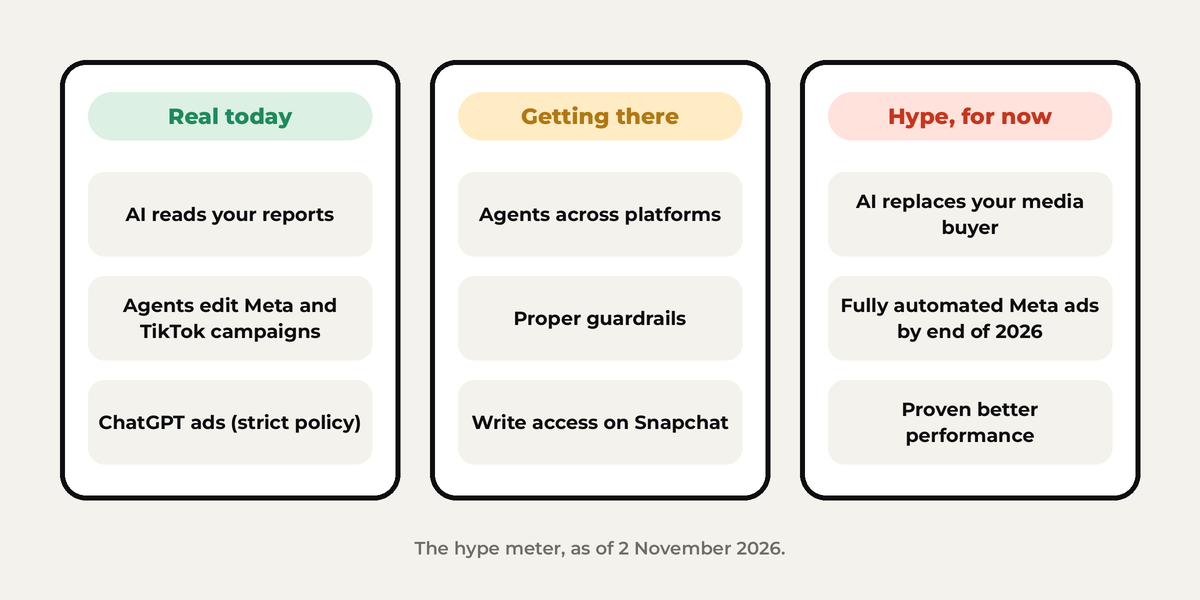
What’s real today
- Meta. Its Ads MCP server has had write access since April 2026: an agent can create and edit campaigns, ad sets and ads. In October Meta announced that its AI business assistant can generate creative and change targeting and budgets by prompt. Parts of that are still in testing.
- TikTok. An MCP server with write access since May, plus the Agentic Hub, a marketplace of AI skills, since June.
- Amazon. A write-enabled MCP server for API partners. Campaigns it builds wait for your approval before they go live.
- Google. Ask Advisor, a Gemini agent that can build campaigns from plain language, went into beta in May. Google says its Ads Advisor asks for approval before acting. The official Google Ads MCP server is read-only.
- Snapchat. Smart Assistant in Ads Manager recommends settings and helps with setup. The MCP server has been live since August, read-only. AI Sponsored Snaps, where brands put AI agents into Chat, is in alpha.
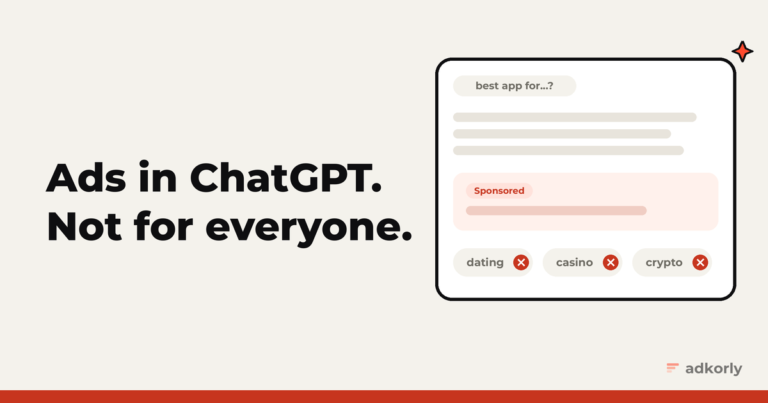
- ChatGPT ads. Live and self-serve in more than 40 countries since August. Before you get excited: OpenAI’s ad policy bans dating, gambling, crypto, most supplements and a long list of other affiliate favourites.
What’s hype (for now)
- “Agents will replace media buyers.” An IAB Europe survey reported by Digiday in September asked ad execs what they actually run. 36 out of 47 had no agentic system in daily use, or one still steered by people. The number one use was reporting.
- “Meta will fully automate ads by the end of 2026.” That was a goal the Wall Street Journal reported in June 2025. Zuckerberg talked about businesses that “connect their bank account and then we just do the rest”. Two months to go, and it’s not here.
- “Agents perform better.” The wins so far are single case studies, self-reported, mostly on CTV. There’s no independent test of agent-run social campaigns against human buyers. Not one I could find, anyway.
- “AdCP is the new standard.” AdCP, the Ad Context Protocol, is real and growing, with 157+ members. But it’s built for programmatic, CTV and audio. Meta, Google, TikTok and Snap aren’t in it. If you buy on Snapchat, ignore it for now.
- Old products with a new label. Advantage+ with the word “agentic” on it is still Advantage+.
What can go wrong
- Your accounts. Digiday reported people claiming Meta restricted their ad accounts after they used Claude Code on their campaigns. Jon Loomer collected similar reports, one advertiser said 17 accounts. Meta hasn’t confirmed a link and some accounts came back. Still not a fun week.
- Permissions you forgot you had. A connector gets everything your user can reach. Including that client’s account you still have access to from 2023.
- Wrong reads. Testers of the Manus AI inside Meta’s Ads Manager saw it misread data. An agent that’s confidently wrong is worse than no agent.
- The AI bill. PPC Land reported one agency employee burning through 1.5 million tokens in a day. Agencies now meter them like media spend.
- The learning phase. An agent that loves to tweak things will reset your learning phase every afternoon. Meta’s own advice: remind it.
- Prompt injection. A web page or a doc can contain instructions that trick your agent. Snap warns about this in its own docs.
Guardrails that actually work
- Read-only first. Reports, audits, anomaly checks. Most of the value is here anyway.
- Draft, don’t launch. New campaigns paused by default. You press the button.
- Hard limits outside the AI. Spend caps on the ad account itself. An agent can’t overspend money that isn’t there.
- Least privilege. Its own login, only the accounts it needs.
- Log everything. What it changed, when, and who approved it.
- Cap the AI’s own spend. A daily token limit, so the robot doesn’t become your biggest expense.
My take for affiliates
Agents are great today at the boring 80%: Monday morning reporting, spotting the ad set that died overnight, building drafts at volume, writing creative variations for you to review.
Humans still win at the part that makes money: picking angles, judging what will get through review, managing accounts and cash.
And agents don’t fix the plumbing. On Snapchat, about 4 in 5 ads we tracked got rejected. An agent that uploads 400 videos faster just collects 320 rejections faster.
That’s why we’re building Adkorly as the rails for agents, not another agent: ad accounts, one wallet, spend limits you set, review data and a log of every action. Snapchat first, more platforms after. Here’s where that’s heading.
What’s the one task you’d hand to an agent tomorrow, and the one you never would? I’m curious where people draw the line. Tell me.
Cheers,
Johannes